
My research is a result of collaboration with many passionate scientists. Below you will find the projects and links to publications.
Together we fight climate change.
#EnergyTransition #ShowYourStripes
BRAVO – Barents Sea Arctic Cenozoic Evolution and Paleogeographical Reconstruction (2023 – now)


BRAVO (Barents Sea Evolution) is a Marie Skłodowska-Curie Actions (MSCA) Global Postdoctoral Fellowship project funded by the European Union’s Horizon Europe (grant 101102324) and the Research Council of Norway (grant 349791) BRAVO is a collaboration between the University of Oslo, Norway and the University of Sydney, Australia.
Read the abstract and follow @BRAVOARCTIC on Twitter and Instagram
Numerical modelling of paleobathymetry and source-to-sink systems in SW Barents Sea

In this study, I numerically modelled the Cenozoic paleobathymetry in the SW Barents Sea. This includes modelling of flexural isostasy, decompaction and thermal subsidence. Then, I used them as input to perform stratigraphic forward modelling for the Eocene clinoform and deep-water fan system. The aim of the project was to simulate the regional Cenozoic source-to-sink system in the SW Barents Sea. This project was funded by Akademia program, a cooperation between Equinor and UiT.
A Review of Cenozoic uplift & erosion of the Barents Shelf
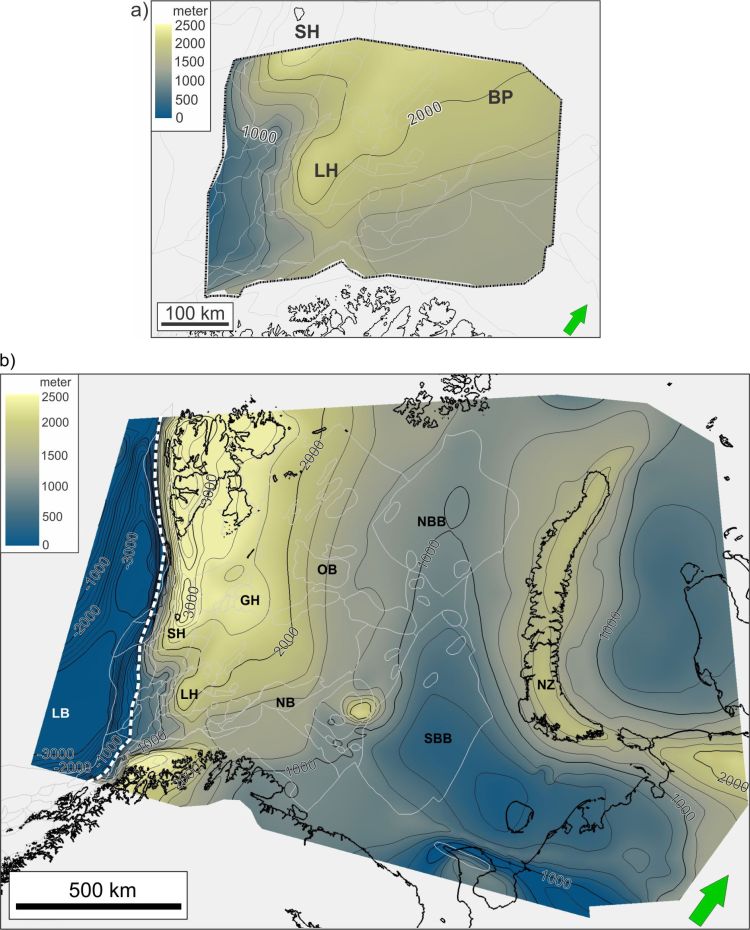
The aim of this study was to present the current status of the Cenozoic uplift and erosion on the Norwegian Barents Shelf by reviewing the key terminology, its tectonic history and paleoenvironment, methods in quantifying uplift and erosion, as well as timing and possible mechanisms.
SW Barents Sea tectonostratigraphy

The aim of this study was to understand the interaction between tectonics and stratigraphy in the SW Barents Sea. Mapping of seismic strata and paleogeographical reconstruction were performed to analyse the source-to-sink system. Volume quantification in the basins was used to estimate the net erosion in the source areas.
NW Barents Sea tectonostratigraphy
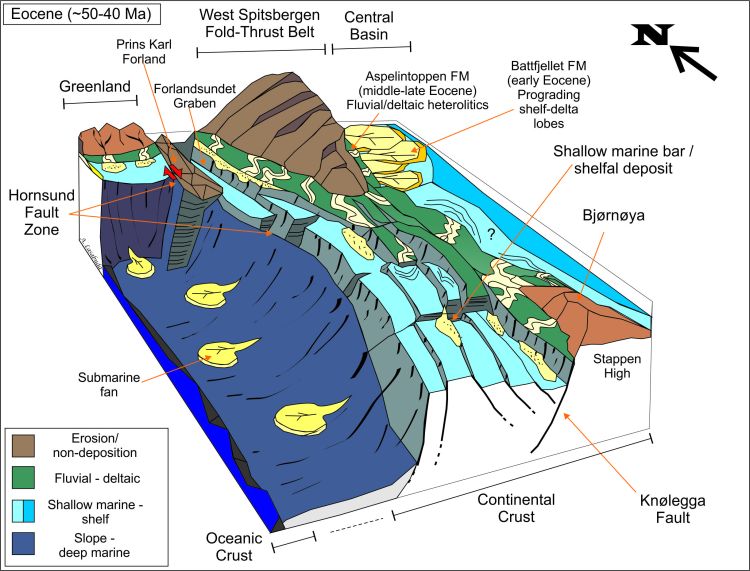
In this paper, I utilised seismic, well and shallow core data to better understand the interplay between tectonics and stratigraphy in response to the Cenozoic plate tectonic development between Greenland and Barents Shelf. Net erosion was estimated based on the mass balance method in the source-to-sink framework.
Modelling of glacial erosion and paleotopography

Have you ever wondered how powerful the Eurasian ice sheet was in eroding Europe’s landscape? This study was led by Dr. Henry Patton (UiT).
Northern Barents Sea and Arctic Ocean
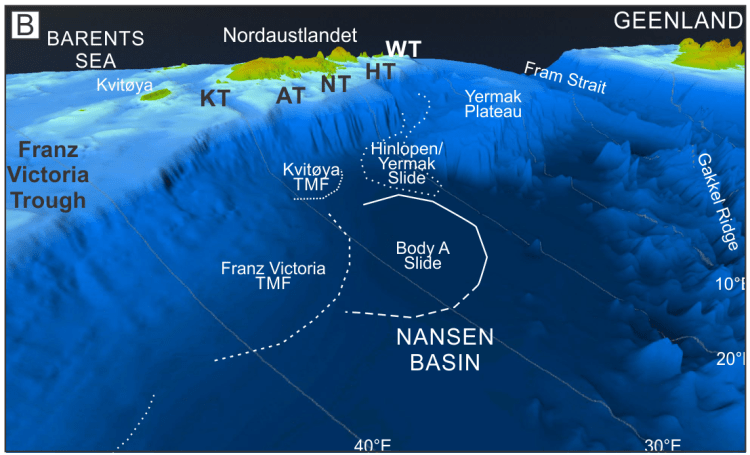
I investigated the net erosion estimate in the northern Barents Shelf. I used the mass balance method (source-to-sink) by integrating isopach thickness maps and different ice sheet models. Seismic data and correlation to the nearest shallow cores were used to constrain the chronology. The results from this paper reflect the sediment input to the Arctic Ocean during the late Cenozoic (the past c. 2.7 Ma).
Gas hydrates-related research

Gas Hydrate Related Bottom-Simulating Reflections Along the West-Svalbard Margin, Fram Strait. A book chapter contribution for World Atlas of Submarine Gas Hydrates in Continental Margins led by Dr. Andreia Plaza-Faverola (UiT).
Contourite, channel and deep-water studies in Norway

What are the factors that influenced the deposition of contourites on passive continental margins during glacial and non-glacial conditions? How was the interplay between along slope vs. downslope processes?
Doctoral dissertation: Cenozoic tectono-sedimentary development (2018)
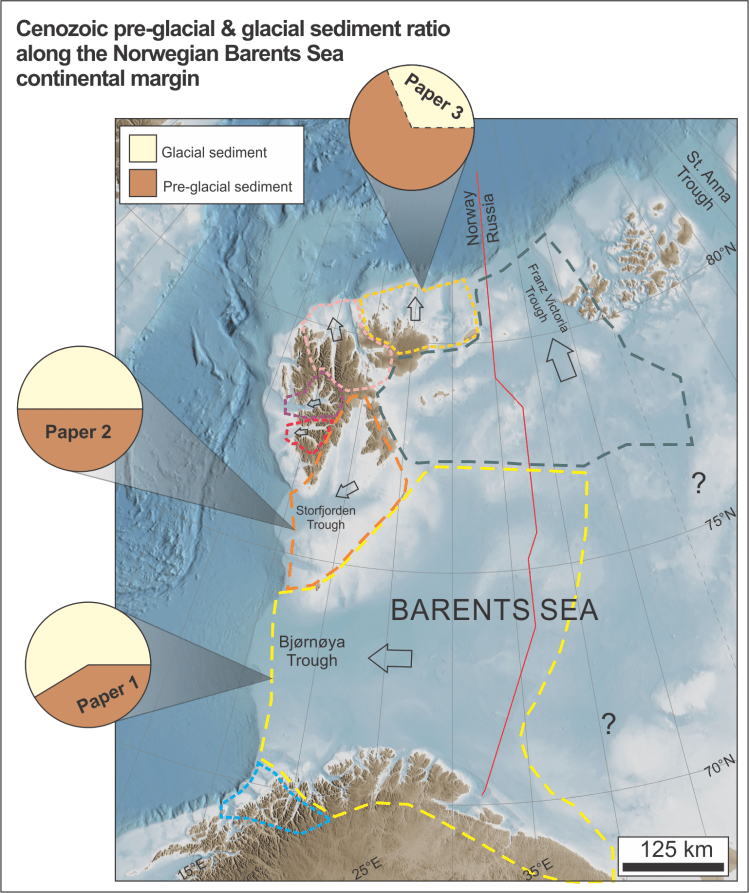
Cenozoic tectonosedimentary development and erosion estimates for the Barents Sea continental margin, Norwegian Arctic
MSc thesis: Submarine channel-levee and fan systems (2013)
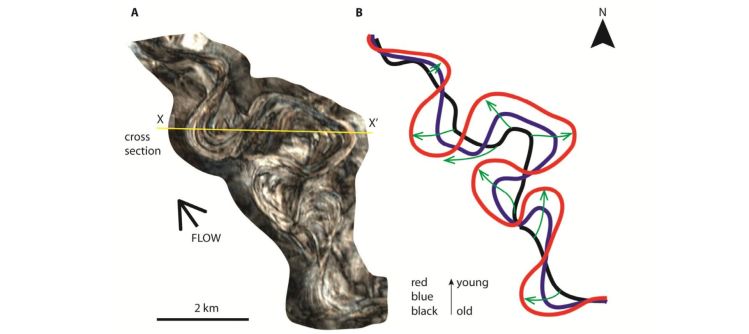
I studied how channel-levee systems respond to salt-influenced slope settings, with a case study from deep-water Egypt. This was in collaboration with Statoil (Now Equinor).
 Dr. Amando Lasabuda