Starting a PhD can be a tough decision to make for some students. It requires courage, commitment and competence to dedicate some years to focus on specific research questions in an effort to advance existing knowledge. Completing a PhD can be even tougher. PhD journey is certainly a marathon, not only for the students but also for the supervisors. Due to its complexity, it often needs an intricate strategy and synergy in all aspects.
Lee (2008, 2019) proposed five approaches (Functional, Enculturation, Critical thinking, Emancipation and Relationship) as a framework for supervising PhD students. In this article, I present my research supervision philosophy on how I supervise PhD students in connection to Lee (2019) five approaches. This article also aims to organize the five approaches by plotting them into a diagram, which links student potential to time (e.g. Lasabuda, 2020). I also explore the concept of the five approaches in research supervision to create an ‘ideal’ PhD graduate.
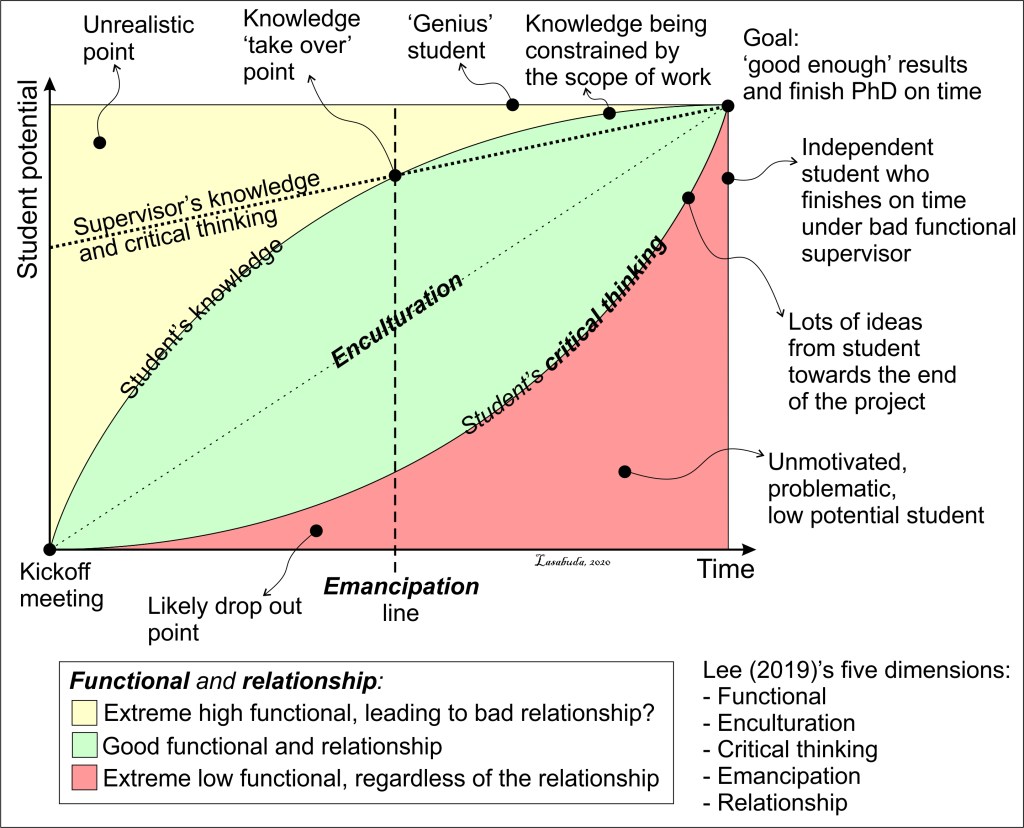
Fig. 1. Variation of student potential based on Lee (2019) five approaches relative to time (Lasabuda, 2020).
Functional
A PhD is considered to be successful when the student is able to pass the ‘good enough’ threshold in producing results within the duration of the PhD period (Fig. 1). One obvious method is through a considerable functional approach performed by the supervisor. The functional approach here is represented by extremely high, good and extremely low functional approaches, which are shown in yellow, green and red zone, respectively (Fig. 1). Extremely high functional approach means that the supervisor exerts too much control and sets strict deadlines as well as other performance indicators on the student. An extremely highly functional approach may likely lead to bad supervisor-student relationship due to constant under ‘pressure’ students.
An extremely low functional approach means that the supervisor performs inadequate control over the student and applies nearly zero milestones or other performance indicators. This can be interpreted as almost no technical guidelines on the project management nor giving any direction during the student’s PhD journey. Regardless of the relationship development with their supervisor, an extremely low functional approach may create problems and a less energetic environment, in particular for students with low potential (Fig. 1). Drop out students may occur in this red zone, resulting in students with low motivation, apart from other external and internal factors (see below)
A good functional approach means good project management conducted by the supervisor to foster the student’s potential through time. The supervisor exhibits the right proportion between enforcing a deadline/milestone and embracing work-life balance.
In my view, the functional approach is very central in the research supervision. The student and I normally set a timetable together to oversee the student’s progress and milestones. This is performed simply in order to be organized to meet deadlines and keep the project ‘tidy’. It is also easier for the student and I if deviations occur along the way, so the student and I can plan ahead and think of strategies to adjust to the changes. One of the success parameters of the functional approach is that the student can stick to their deadlines, commit to their milestones and meet their targets, which is all-in-all reflected by finishing their PhD on time.
Enculturation
Enculturation is a transformation process of a student from a ‘newbie’ scientist into a ‘blended-and-get-along’ scientist. The process of integration includes attending relevant conferences and being actively involved in research group meetings. All of these activities, which are likely set or encouraged by the supervisor, will increase the sense of belonging and pride of the discipline community. Enculturation is shown in the diagram as a dashed line, meaning that the trajectory may vary as long as it lies within the green zone i.e. good function and relationship (Fig. 1).
On a smaller scale, I use a group meeting that can be treated as an arena for the PhD students to discuss their findings and to update every group member on their progress. On a broader scale, I strongly encourage my students to attend relevant conferences and present their results. In this way, they will learn how others do science and present their results. Very often they will see ‘big names’ in the discipline and they will have chances to talk casually and discuss science. This has a good physiological effect on the students that the famous scientist is just a ‘normal’ person, and that is often nice and friendly. Major conferences normally have a forum for Early Career Researchers, so that the students can build their own network and meet potential collaborators in the future.
Critical thinking
Supervisors must not dictate the research and promote the free thinker principle, but at the same time lead the way (Due et al., 2011). The supervisors should ask intriguing questions to stimulate discussion and therefore sharpen the student’s critical thinking. Critical thinking is the top priority skill voted by supervisors in a survey performed by Lee (2018). Critical thinking of the student is expected to be exponentially increased towards the end of a PhD (Fig. 1). This explains why student’s ideas grow flourishingly at the latest stage of a PhD. In contrast, the knowledge of a student will eventually ‘flatten’ towards the end of a PhD due to the project scope-of-work and time constraints (Fig. 1).
My view on critical thinking is that this is the most essential skill for the student. The student is expected to develop their critical thinking when encountering a problem or addressing a new concept. The key task for the supervisor is to polish their student’s critical thinking skills during the PhD period. Examples of questions that promote critical thinking are, “Why do you do this approach?”, “What is the key uncertainty in that method?” and “What is the implication if we do this instead of that?”. These are typical bread-and-butter questions we face as a scientist, such as in a seminar/dissemination, proposal writing and peer-review processes. One of the possible success parameters of critical thinking after PhD graduation is a contribution to reviewing a manuscript for a journal as part of the peer-review process.
Emancipation
Emancipation largely means that the student emerges as the primary driver of the PhD project instead of the supervisor. I propose a concept of the “emancipation line”, which marks this transition and commonly coincides with the knowledge “take over” point (Fig. 1). I define this point as when a student’s knowledge about a particular subject exceeds the supervisor’s knowledge. This may be factual as the student focuses and constantly investigates the research questions and therefore, the student will eventually have more knowledge than the supervisor.
However, there may be a case when the student still emancipates but their level of knowledge of the project is still below or the same as their supervisor at the end of the PhD period i.e. without passing the knowledge “take over” point. This likely occurred in an extremely low functional approach (see above).
In my view, the emancipation line may be shifted to left or right in the diagram depending on several factors, such as the student capability (i.e. knowledge about the project), critical thinking, relationship with the supervisor and enculturation (Fig. 1). If there is a positive interrelation of these factors, then the emancipation may appear earlier. One of the great hallmarks of the emancipation approach is when the student is able to write a short proposal aiming for a smaller grant for fieldwork, laboratory work, or as a sidetrack for the PhD project based on their original ideas.
Relationship
The relationship between a supervisor and every student is unique and therefore may vary in each PhD project. Here, a supervisor is required to have the capability to adjust their supervisory style to the student i.e. being flexible in applying the five approaches throughout the project.
From my viewpoint, the supervisor’s major role is to become a motivator for the student. It is important to ‘keep the heat on’, to maintain the student’s motivation as it can be quite challenging in a longer period. A motivated, smart student is much more valuable than a clever one with low motivation to complete a PhD. Relationships should be built based on mutual respect and trust. The supervisor shall respect the student as a learner, a human being and perhaps has other personal roles in life (e.g. a husband, wife or partner). Mutual trust is also crucial, where the supervisor trusts the student that they will commit to their PhD project. The student should also trust the supervisor that they will receive professional guidance. Supervisors should be appreciative of student’s progress although it may look like a ‘baby step’. An example of a healthy relationship is when the student becomes a good colleague and/or collaborator for a project even if they are in a different institution in the future.
Synthesis on the ‘ideal’ profile of PhD graduate based on Lee (2008, 2019)’s approaches
In this chapter, I explore the likely ‘ideal’ profile of a PhD graduate based on the five approaches of Lee (2019). The interrelationship between different approaches as suggested by Lee (2019) is shown in Fig. 2a. She directly connected Enculturation, Critical thinking, Emancipation and Relationship, where they are set within a Functional approach. This diagram can be interpreted as there is considerable Functional control from the supervisor in the other four approaches to the PhD student. Excessive domination over a PhD student may jeopardize the supervisor-student relationship (see Fig. 1). Moreover, we know that a supervisor may pose a different dominant approach during research supervision. Some supervisors tend to combine two predominant approaches (Lee, 2019). Therefore, a supervisory team, which is composed of supervisors with different backgrounds and experiences, is expected to ideally cover all of the approaches. In this chapter, I use ‘supervisory team’ instead of a single supervisor to strengthen the importance of collaborative teamwork among supervisors during a PhD journey.
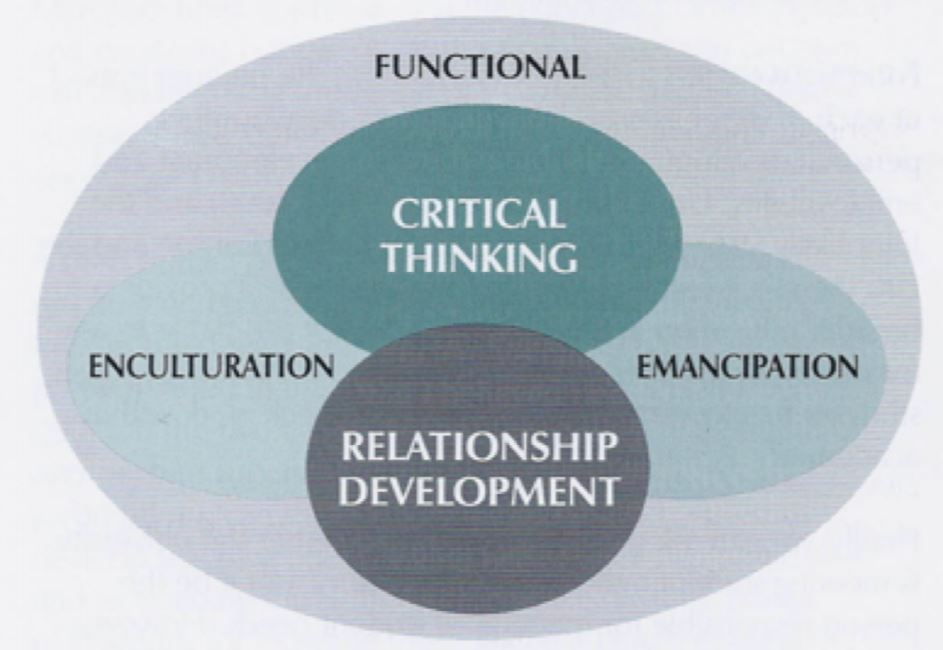
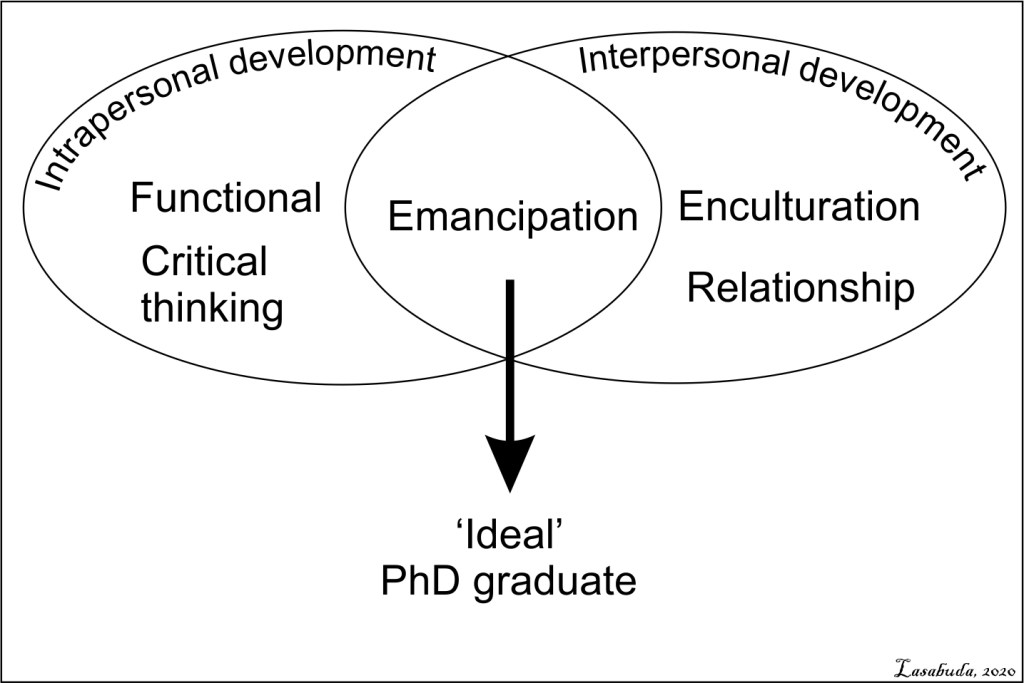
Fig. 2. a) How Lee (2019) formulated the interaction of the five approaches. b) This synthesis suggestion on linking Lee (2019) approach to the ‘ideal’ profile after earning a PhD (Lasabuda, 2020).
Emancipation may also arise from predominantly intrapersonal development, where functional and critical thinking are the governing approaches that are performed by the supervisory team. The PhD graduate will likely only concentrate on producing papers. This may be particularly good for an academic, however, this PhD graduate will likely lack socio-scientific and interpersonal skills due to missing enculturation and relationship components. Under extreme functional conditions, the student may even finish their PhD earlier (see Fig. 1). This case may also be amplified by the student’s high intelligence level i.e. ‘genius’ student and the one with exceptionally strong ambition.
If the supervisory team mainly performs enculturation and relationship approaches, then the PhD graduate may emancipate with mainly interpersonal development. As a result, the PhD graduate will likely have a profile with low core competency. This PhD profile is suitable for making connections with other scientists and building relationships with their collaborators or future students. However, a lack of critical thinking is rather unfortunate for a PhD graduate. In addition, a lack of a functional approach will result in a significant delay in submitting a manuscript and scattered work progress. The student may still manage to finish on time, but it might be that they do not utilize their 100% potential capacity unless they show a great deal of independence and perseverance (Fig. 1).
If all of the five approaches are performed well by the supervisory team, then the PhD graduate will likely have a complete profile of an ‘ideal’ PhD graduate. Remember that the key task as supervisors is to optimize student’s potential. The PhD graduate is expected to fill all the key values as a scientist, derived from the five approaches (Fig. 2b). They are projected to pass the ‘good enough’ threshold, including finishing on time, maintaining good project management, immersing in the scientific community, showing critical thinking, acquiring the sense of ownership of the new knowledge from PhD project and developing a good relationship with the supervisors.
Note that the lack of other approaches performed by a supervisory team may be compensated by other factors, such as the student’s mentality and inherent intellectual capacity, which are the primary components to fulfill the lacking approaches. For example, a student with high discipline, who sticks to the timeline and meets deadlines will survive under a supervisory team with a lack of functional approach. Another example is that students who are part of big and active research groups will likely be more enculturated although their supervisory team lacks of enculturation approach. The students will likely get influence or advice from their peers about being part of the science community such as conferences and seminars.
Acknowledgement
I would like to thank Rizky S. E. Lasabuda (PhD student at Achucarro Basque Center for Neuroscience, Spain) for commenting on an earlier draft of this work. This work is licensed under a Creative Commons Attribution 4.0 International License.
References
Due, J., Kobayashi, S. and Rump, C.Ø., 2011. To lead the way: inspiration for PHD students and their supervisors.
Lasabuda, A.P.E., 2020. Interpretation of Lee (2019)’s five dimensions through time and linking them to an ‘ideal’ PhD graduate. http://doi.org/10.5281/zenodo.4270547
Lee, A., 2008. How are doctoral students supervised? Concepts of doctoral research supervision. Studies in Higher Education, 33(3): 267-281.
Lee, A., 2018. How can we develop supervisors for the modern doctorate? Studies in Higher Education, 43(5): 878-890.
Lee, A., 2019. Successful research supervision: Advising students doing research. Routledge.
 Dr. Amando Lasabuda